AI Agents for Financial Compliance
AI agents are reshaping financial compliance with 200–2,000% productivity gains—if they can access your real regulations, policies, and procedures. Learn how MCP and Akyn connect assistants like Claude, Gemini or ChatGPT to audit-ready compliance knowledge bases.

AI agents for financial compliance are rapidly moving from pilot projects to production deployments. Across AML, surveillance, and regulatory change workflows, compliance teams are reporting productivity gains of 200 to 2,000 percent by automating investigation steps, triage, and documentation.
This isn't theoretical. HSBC reports detecting two to four times more suspicious activity while reducing false alerts by 60%. JPMorgan says it generates $1.5 billion annually from AI, with over 200,000 employees using its internal LLM tooling. And these are just the headline numbers. The shift toward AI agents in compliance is happening across every function.
From Manual Review to Agentic Compliance
Traditional compliance programs rely on periodic reviews, fragmented evidence trails, and manual interpretation of policies. AI agents change this model by continuously monitoring signals, drafting case narratives, suggesting next best actions, and routing work to the right human reviewer.
The result isn't just speed. It's higher coverage, more consistent decisioning, and a fundamentally different operating model. But this only works when the agent is grounded in the firm's actual rules and documentation.
Five High Impact Use Cases for AI Agents in Financial Compliance
AML/KYC: Perpetual Monitoring Instead of Periodic Refresh
AI agents enable continuous KYC monitoring, keeping customer risk profiles current without waiting for scheduled review cycles. Instead of updating client files once a year, compliance teams can now flag changes in real time. JPMorgan has cited up to a 95% reduction in false positives by applying AI agents to risk and alerting workflows.
Sanctions Screening: Less Noise, Same Accuracy
Sanctions screening teams are using AI agents to cut alert volume while preserving strict match quality. SymphonyAI reports 80% fewer false positives while maintaining 100% accuracy in benchmarked deployments. For compliance teams drowning in false matches, this is one of the fastest paths to measurable ROI.
Trade Surveillance: Faster Resolution with Multi Modal AI
Modern trade surveillance spans chats, tickets, orders, market data, and voice recordings. Investigating a single alert can require piecing together evidence from half a dozen systems. Solidus Labs highlights 20x faster alert resolution when multi modal AI helps investigators connect evidence across channels automatically.
Communications Monitoring: Across Teams, Slack, and Email
Communications surveillance is notoriously noisy. Most alerts turn out to be benign, and reviewers spend the majority of their time clearing false positives. Smarsh reports a 95% reduction in false positives when AI is applied across collaboration and messaging platforms, letting reviewers focus on the interactions that actually pose risk.
Regulatory Change Management: Real Time Obligations Mapping
Instead of waiting weeks to assess new rules, AI agents can monitor regulatory updates, classify obligations, and map them to internal controls and policies. This eliminates the typical 90 day assessment lag that many financial institutions struggle with, and ensures that compliance programs stay current as regulations evolve.
The Critical Challenge: Connecting AI Agents to Your Compliance Knowledge
Here's the catch. Generic AI models are not compliance systems.
Without access to your specific regulations, internal policies, procedures, and control language, they will hallucinate, answer generically, or miss firm specific constraints. In regulated environments, that's not just inconvenient. It's unacceptable. You need traceability, recency, and governance over what the AI can see and cite.
This is where the Model Context Protocol (MCP) becomes essential. MCP acts as a universal connector between AI assistants (Claude, ChatGPT, Cursor, n8n, and other MCP compatible clients) and your knowledge sources. Instead of the AI guessing, it retrieves the right documents before responding. This makes AI agents for financial compliance practical and auditable, rather than a black box.
How Akyn Makes AI Agents Compliance Ready
Akyn helps compliance teams and knowledge owners publish AI ready knowledge bases that connect to any MCP compatible assistant, without custom integrations or engineering effort. The entire setup takes minutes, not months.
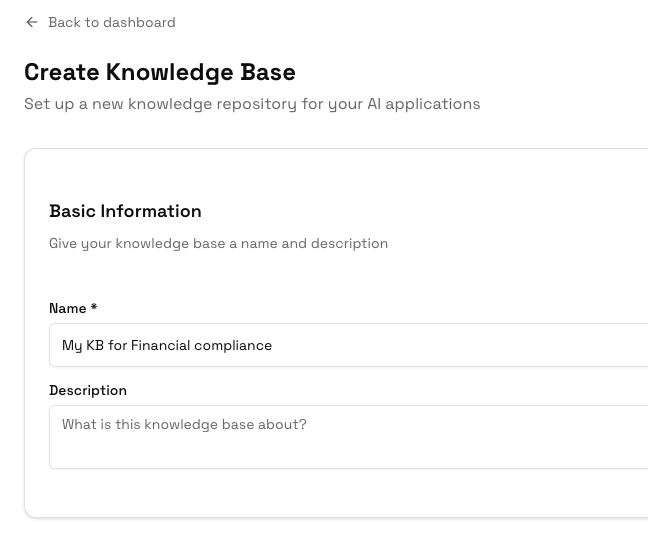
Step 1: Create a Knowledge Base
Go to akyn.dev and create a new knowledge base. You choose whether it's private (restricted to your team) or public (accessible to anyone with the MCP URL). Private knowledge bases are ideal for internal policies and procedures. Public ones work well for regulatory content you want to share across the organization or externally.
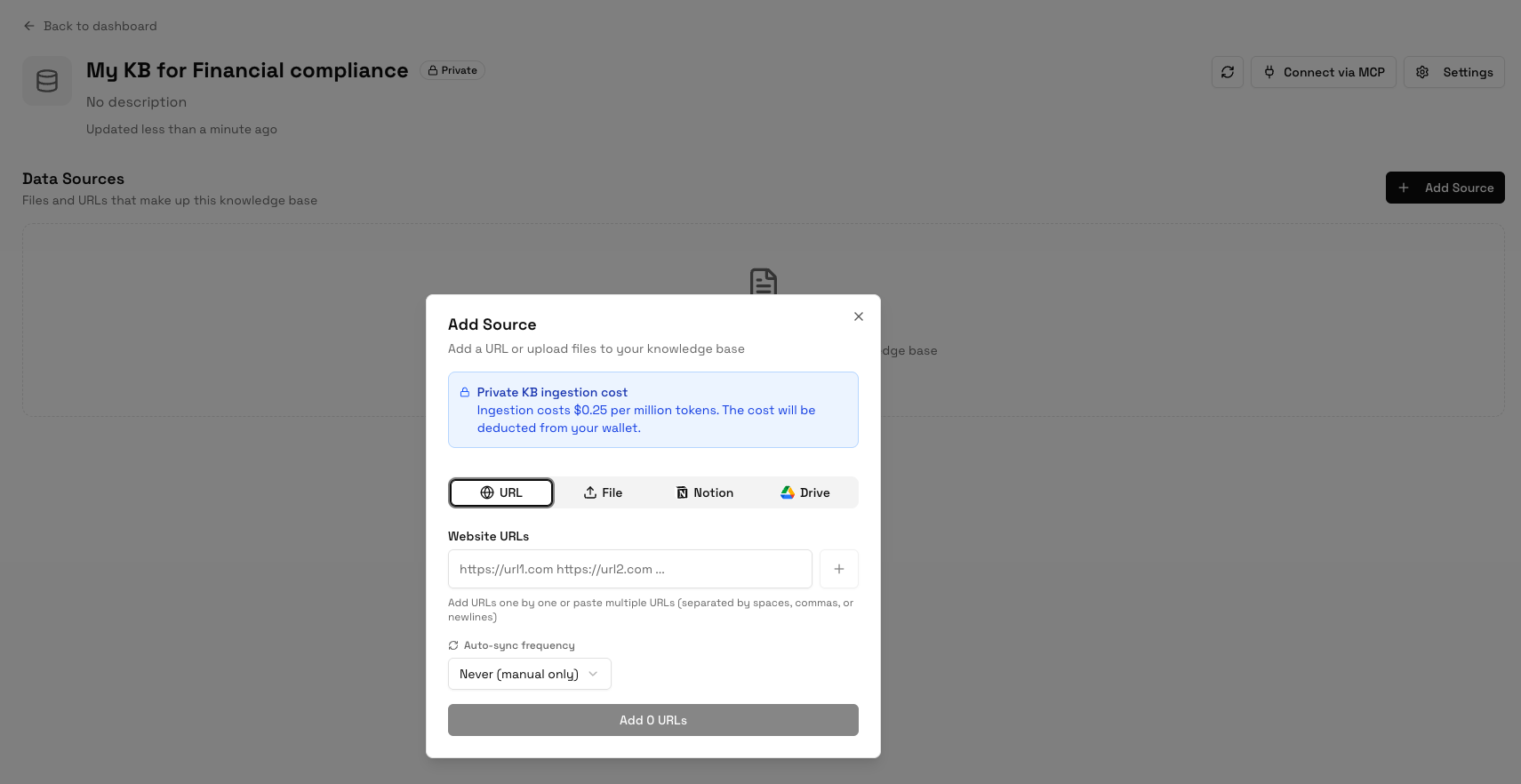
Step 2: Add Your Compliance Sources
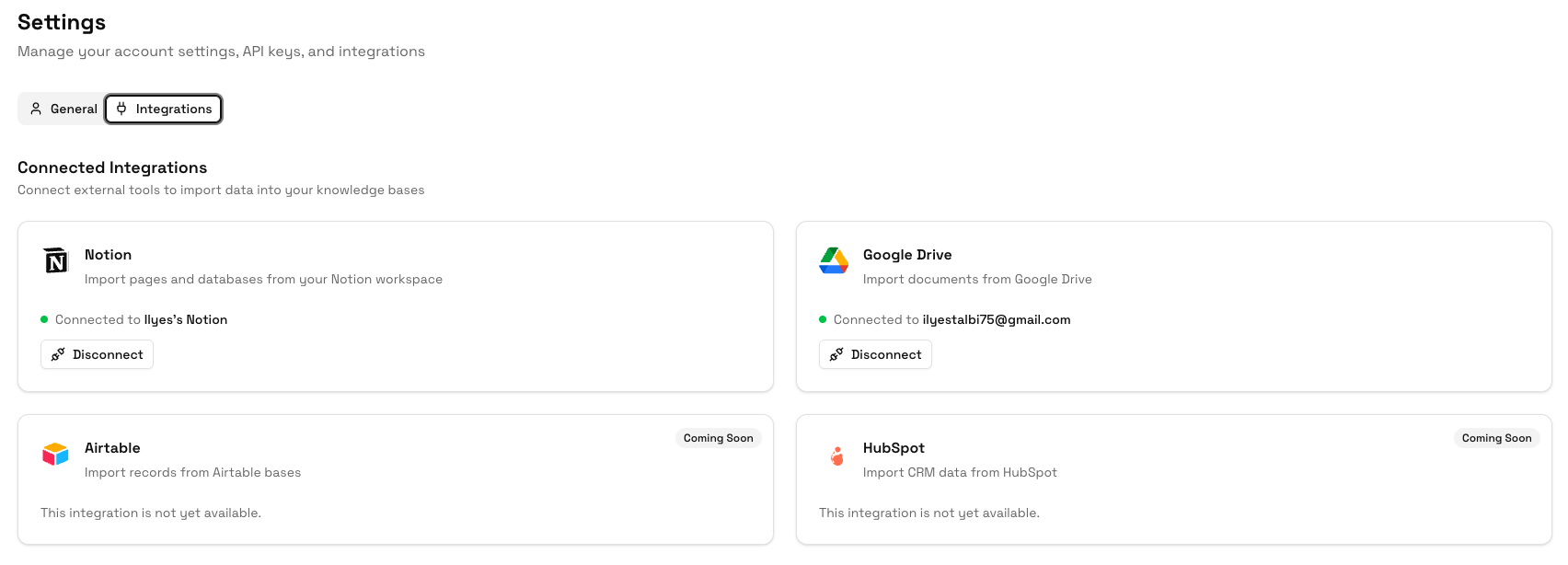
Import your compliance content by selecting the source types that match where your documentation lives. You can upload PDFs, Markdown, or Word documents directly, which works well for regulations, procedures, and case law. You can point to URLs for regulatory websites, policy pages, or any web based documentation. And you can connect Notion (setup guide) or Google Drive (setup guide) to pull in entire workspaces. More integrations are coming soon.
Akyn automatically normalizes all content and generates vector embeddings for semantic retrieval, so your team can search by meaning rather than exact keywords.
Step 3: Set Up Automatic Syncing
For URL, Notion, and Google Drive sources, you can configure an ingestion frequency. Akyn will periodically check whether the source content has changed. If it has, the knowledge base updates automatically and you receive an email notification. This means your AI agent always works from the latest version of your compliance documents, with no manual re imports needed. For compliance teams tracking evolving regulations, this is essential.
Step 4: Connect to Your AI Assistant
Once your knowledge base is ready, grab the MCP server URL from your Akyn dashboard.
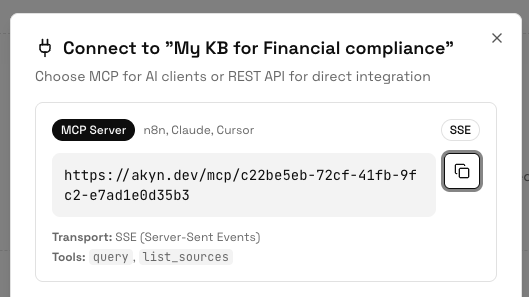
Then connect it to whatever AI client your team uses. The same MCP URL works with Claude, ChatGPT, n8n, Cursor, and any other MCP compatible client.
Here's how it works with Claude as an example. In the Claude chat input, click the + button and select "Add connectors". Then click "Manage connectors" to open connector settings, and click "Add a custom connector". Enter a descriptive name for your knowledge base and paste your Akyn MCP URL, which follows the format https://akyn.dev/mcp/[your-kb-id]. Click "Connect" and complete the OAuth authorization. You can optionally configure whether Claude calls the tools automatically or asks for approval each time.
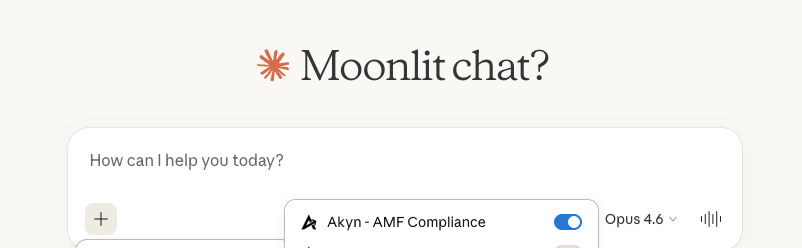
That's it. Claude can now query your compliance knowledge base in real time. Ask it things like "What's our GDPR data retention policy?" or "Summarize the latest AMF guidance on client categorization" and it will answer using your actual documents, with full traceability back to the source.
You can add multiple connectors, one per knowledge base, so Claude knows which source to use for different topics. A team might have one knowledge base for internal policies, another for AMF regulations, and a third for SEC filings.
Compliance Knowledge Bases Already in Production
Several compliance focused knowledge bases are already live on Akyn and available for teams to connect. These include an AMF Compliance knowledge base covering French financial regulator content, a Jurisprudence AMF collection of case law and rulings searchable by any MCP connected assistant, and a SEC Filings Search knowledge base for US regulatory filings that stays automatically up to date.
These examples illustrate how AI agents for financial compliance become dramatically more useful when they can retrieve real, current regulatory content instead of relying on training data alone.
Why Akyn for Compliance AI Agents
Akyn isn't just a document store. It's built for the operational reality of compliance deployments.
Access control lets you decide exactly who and which AI agents can reach each knowledge base, with private and public options. Usage analytics show how your knowledge is being queried, by whom, and how often, giving compliance officers visibility into how AI is being used across the team. Automatic syncing keeps sources current without manual intervention, which matters when regulations change frequently. And the entire setup requires no engineering work: you create a knowledge base, get an MCP URL, and connect it.
For organizations that have built expert compliance knowledge, Akyn also supports monetization, letting you publish knowledge bases that others can subscribe to and connect to their own AI workflows.
The Bottom Line
AI agents for financial compliance can deliver outsized gains in productivity, coverage, and consistency. But they only work when connected to the right, verified context. The combination of AI agents and MCP connected knowledge bases is the practical path to safe adoption: answers grounded in current documentation, clear governance, and audit ready traceability.
If you're building compliance AI agents or enabling teams to use Claude, ChatGPT, or any AI assistant safely in a regulated environment, Akyn is designed to make your institutional knowledge usable everywhere it matters.
Get started at akyn.dev